Local Citations and NAP Consistency: Why They Matter for Local SEO and AI Search
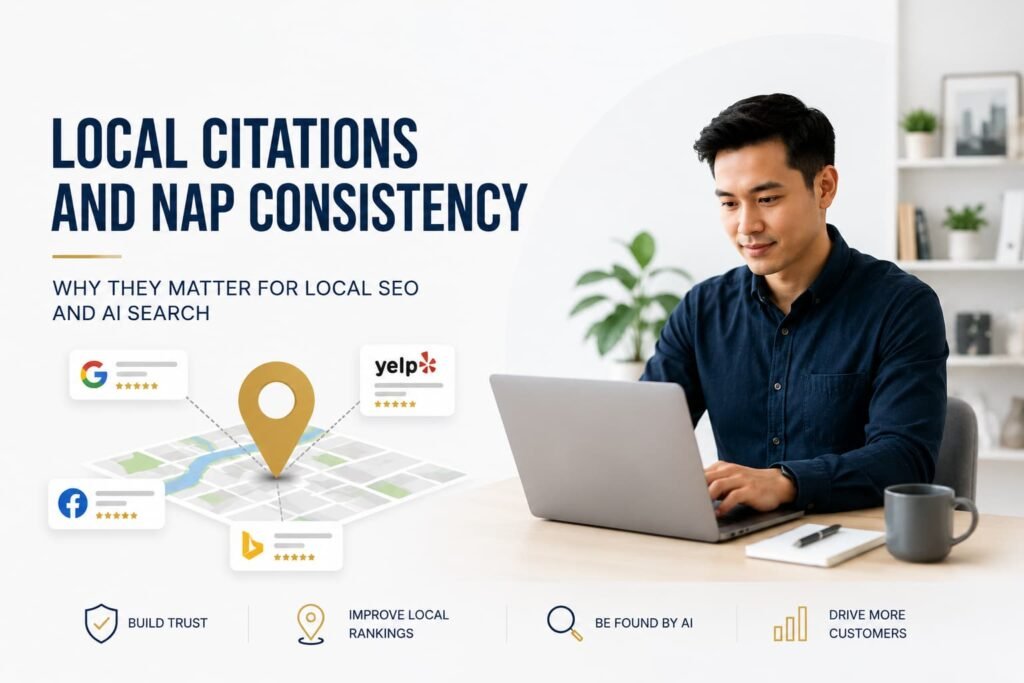
A local citation is any online mention of your business name, address, and phone number, and getting that information consistent everywhere is one of the oldest local SEO fundamentals there is. It’s also becoming one of the most important signals for a newer problem: helping LLMs and AI Overviews find, trust, and correctly recommend your business.
TL;DR: A local citation is any mention of your business’s name, address, and phone number (NAP) on a directory, platform, or data aggregator. Consistency across every citation, matching your Google Business Profile exactly, is what builds trust with both Google’s local algorithm and AI search tools. Structured citations, the kind stored as discrete labeled fields rather than a plain-text mention, function like semantic triples: machine-readable facts that LLMs can read, verify, and cite confidently when someone asks an AI assistant for a local recommendation.
Table of Contents
- What Are Local Citations?
- Structured vs. Unstructured Citations
- Why NAP Consistency Is the Foundation of Local Citations
- How Local Citations Affect Your Local SEO Rankings
- Semantic Triples: How Structured Citations Help LLMs Understand Your Business
- Where to Build and Manage Local Citations
- How to Do a Local Citation Audit
- Fixing and Preventing NAP Inconsistencies
- Local Citations for Multi-Location and Service-Area Businesses
- FAQ
What Are Local Citations?
A local citation is any online mention of your business name, address, and phone number, commonly shortened to NAP. That mention can live on a general directory like Yelp, an industry-specific listing, a data aggregator, the local Chamber of Commerce, a review platform, or a map service. Your Google Business Profile is technically a citation too, and the most important one, since it feeds directly into the Google local pack and Google Maps.
Citations do two jobs at once. For search engines, a large, consistent set of citations is a trust signal: if dozens of independent sources agree on your business’s name, address, and phone number, that agreement is hard to fake, and Google treats it as evidence your business is legitimate and correctly located. For AI Overviews and LLM-based assistants, that same consistency is what makes it safe to cite your business by name in an answer, more on that below.
Structured vs. Unstructured Citations
Not every citation is built the same way, and the distinction matters for both traditional SEO and AI visibility.
| Factor | Structured Citation | Unstructured Citation |
|---|---|---|
| Format | Discrete, labeled fields (Name field, Address field, Phone field) | Free-text mention inside an article, review, or press piece |
| Where it lives | Business directories, data aggregators, GBP, Yelp, industry listings | News articles, blog posts, social media mentions, forum posts |
| Machine readability | High, easy for search engines and LLMs to parse and verify | Lower, requires natural language understanding to extract |
| Best for | Establishing verifiable, consistent NAP data at scale | Building brand awareness and topical relevance |
| Relationship to semantic triples | Functionally already triple-shaped (entity, attribute, value) | Not inherently structured, though schema markup can add structure |
Both types have value, but structured citations are the ones doing the heavy lifting for local pack rankings and for AI search visibility, since they’re the easiest for a machine to confidently read.
Why NAP Consistency Is the Foundation of Local Citations
Consistency matters more than volume. If your phone number is formatted one way on your website, another way on Yelp, and a third way on an industry directory, every system reading that data, human or machine, has to guess which version is correct. That uncertainty weakens trust in your listings across the board.
The consumer research backs this up directly: 80% of people lose trust in a business after seeing incorrect or inconsistent contact details online, and 68% say they’d stop using a business after finding incorrect information on a directory listing. Before building new citations, audit and correct the ones you already have. A short, accurate list of citations that all match your Google Business Profile exactly will consistently outperform a long list full of conflicting information.
How Local Citations Affect Your Local SEO Rankings
Citations have been a foundational local ranking factor for years, and recent industry research shows their role is shifting rather than disappearing. Whitespark’s 2026 Local Search Ranking Factors Report found that citation consistency has slipped somewhat as a weight in the traditional Google local pack algorithm compared to previous years. At the same time, the same report flags renewed importance for citations in a different context: AI search visibility, where the report describes mentions and citations as “the new link,” noting that three of the top five ranking factors for AI visibility are citation-related.
In practical terms, that means citations haven’t gotten less important, they’ve become important for a second reason. A clean, consistent citation profile still supports your local pack and Maps rankings, and it’s now also one of the clearest ways to earn visibility in AI Overviews and LLM-generated local recommendations.
Semantic Triples: How Structured Citations Help LLMs Understand Your Business
A semantic triple is a simple way of representing a fact as three parts: a subject, a predicate, and an object, for example, [Your Business] → has phone number → (615) 499-6013. This is the underlying structure behind knowledge graphs, schema.org markup, and increasingly, how LLMs assemble a confident answer about a local business. It’s also, not coincidentally, exactly what a structured citation already is: a business name paired with a specific, labeled attribute and value.
When your NAP data is identical across every structured citation, Google Business Profile, Yelp, industry directories, data aggregators, and your own website’s schema markup, you’re effectively publishing the same set of semantic triples in dozens of independently verifiable places. That redundancy is exactly what an AI system looks for before it’s willing to state a fact confidently: if ten independent sources agree your business is at the same address with the same phone number, an LLM can cite that information with much higher confidence than if it only has one unverified mention to go on.
NAP as a Semantic Triple
Concretely, a well-built citation profile is already producing structured facts like these, repeated consistently everywhere your business is listed:
- [Business Name] → hasAddress → [Street, City, State, ZIP]
- [Business Name] → hasTelephone → [Phone Number]
- [Business Name] → hasCategory → [Primary Service or Specialty]
- [Business Name] → servesArea → [City or Region]
Pairing that consistency with LocalBusiness or Service schema markup on your own website reinforces the same triples in a format search engines and LLMs are both built to parse directly, which is part of why optimizing for LLMs and traditional search engines is one connected local SEO offering at Lift SEO Services rather than two separate projects. See AEO, GEO, and SEO for more on how we approach AI-driven search alongside traditional Google results, and our Local SEO for Small Business page for how citation work fits into a full local SEO engagement.
Where to Build and Manage Local Citations
Start with the citation that matters most: your Google Business Profile, since it’s the primary source both Google’s local algorithm and AI Overviews pull from. From there, prioritize the handful of broad, high-authority general directories (Yelp, Apple Maps, Bing Places, Facebook), the major data aggregators that redistribute your NAP data to dozens of smaller sites automatically, and any directory specific to your industry (healthcare-specific directories for medical practices, trade-specific directories for home service businesses).
Citation Management Tools and Data Aggregators
A handful of established tools exist specifically to help businesses build and monitor citations at scale, among them Moz Local, BrightLocal, Whitespark, and Yext. Each takes a slightly different approach (citation building, citation tracking and auditing, or direct data aggregator distribution), but the goal is the same: get consistent NAP data into as many verifiable, structured places as possible, and catch inconsistencies before they spread further.
How to Do a Local Citation Audit
- Search your business name and phone number to surface citations you may not know exist, including old or duplicate listings.
- Compile every citation you find into a single list, noting the exact name, address, and phone number shown on each one.
- Compare each listing against your Google Business Profile, since that should be your source of truth for NAP formatting.
- Flag every inconsistency, a missing suite number, an old phone number, an abbreviated street type, anything that doesn’t match exactly.
- Correct or claim each listing, prioritizing your highest-authority citations first (Google, major aggregators, industry-specific directories).
- Remove or merge duplicate listings rather than leaving both live, duplicates create the exact inconsistency you’re trying to eliminate.
Fixing and Preventing NAP Inconsistencies
- Pick one exact NAP format (including abbreviations like “St.” vs. “Street”) and use it everywhere, starting with your Google Business Profile
- Audit existing citations before building new ones, fixing what’s wrong outweighs adding more volume
- Correct old addresses and phone numbers immediately after a move or number change, across every listing, not just your website
- Remove or merge duplicate listings rather than leaving multiple versions live
- Add matching LocalBusiness or Service schema markup to your website so your own site reinforces the same NAP data
- Re-check your top citations periodically, data aggregators occasionally reintroduce outdated information
- Keep a single internal record of your official NAP format so anyone updating listings uses the same source of truth
Local Citations for Multi-Location and Service-Area Businesses
Citation management gets more complex once more than one location or provider is involved. A healthcare practice with multiple providers, or a home service business covering several cities, needs every location or service area represented accurately and separately, without letting listings blur together or duplicate. Manage every location through one account rather than scattered individual logins, and keep category and NAP formatting consistent across locations even as service area and contact details change per site. See Healthcare SEO Services and SEO for Home Service Businesses for guidance specific to each vertical, and what local SEO is and why it matters for healthcare and home service businesses for the fundamentals this article builds on.
Not Sure How Consistent Your Citations Are?
We’ll audit your NAP data across your top citations and show you exactly what’s inconsistent, no obligation.
Frequently Asked Questions
What are local citations in SEO?
A local citation is any online mention of your business name, address, and phone number, on directories, industry listings, data aggregators, or your Google Business Profile. Consistent citations help both search engines and AI tools trust and correctly represent your business.
What does NAP consistency mean, and why does it matter?
NAP consistency means your business name, address, and phone number are formatted identically everywhere they appear online. It matters because mismatched information erodes trust, 80% of consumers lose trust in a business after seeing incorrect or inconsistent contact details, and it makes it harder for Google and AI tools to confidently verify your business.
What’s the difference between structured and unstructured citations?
A structured citation stores your NAP data in discrete, labeled fields, like a directory listing or your Google Business Profile, making it easy for machines to read and verify. An unstructured citation is a free-text mention, like a news article referencing your business by name, which is harder for automated systems to parse precisely.
What are semantic triples, and how do they relate to local citations?
A semantic triple represents a fact as a subject, predicate, and object, for example, a business paired with its phone number. A structured citation is already shaped like a semantic triple. When the same NAP triples appear consistently across many independent citations, LLMs and AI Overviews can verify and cite that information with much higher confidence.
How do local citations affect AI Overviews and LLM search results?
AI Overviews and LLM-based assistants look for corroborating, consistent facts before confidently recommending a business. A wide, consistent set of structured citations gives them exactly that, according to Whitespark’s 2026 ranking factors research, citation-related signals now make up three of the top five factors in AI search visibility.
Where should I build citations first?
Start with your Google Business Profile, since it’s the primary source Google’s local algorithm and AI Overviews both pull from. From there, prioritize major general directories, the data aggregators that redistribute NAP data automatically, and any directory specific to your industry.
How do I run a local citation audit?
Search your business name and phone number to surface every existing citation, compile the results into a list, compare each one against your Google Business Profile, flag every inconsistency, and correct or merge listings starting with your highest-authority citations.
Does Lift SEO Services manage citations and NAP consistency as part of local SEO?
Yes. Citation auditing and NAP consistency are part of every local SEO engagement at Lift SEO Services, built alongside schema markup and Google Business Profile management so your business is represented identically everywhere, for traditional search engines and for LLMs and AI Overviews.
-
Local SEO Ranking Factors: What Actually Determines Local Search Rankings
-
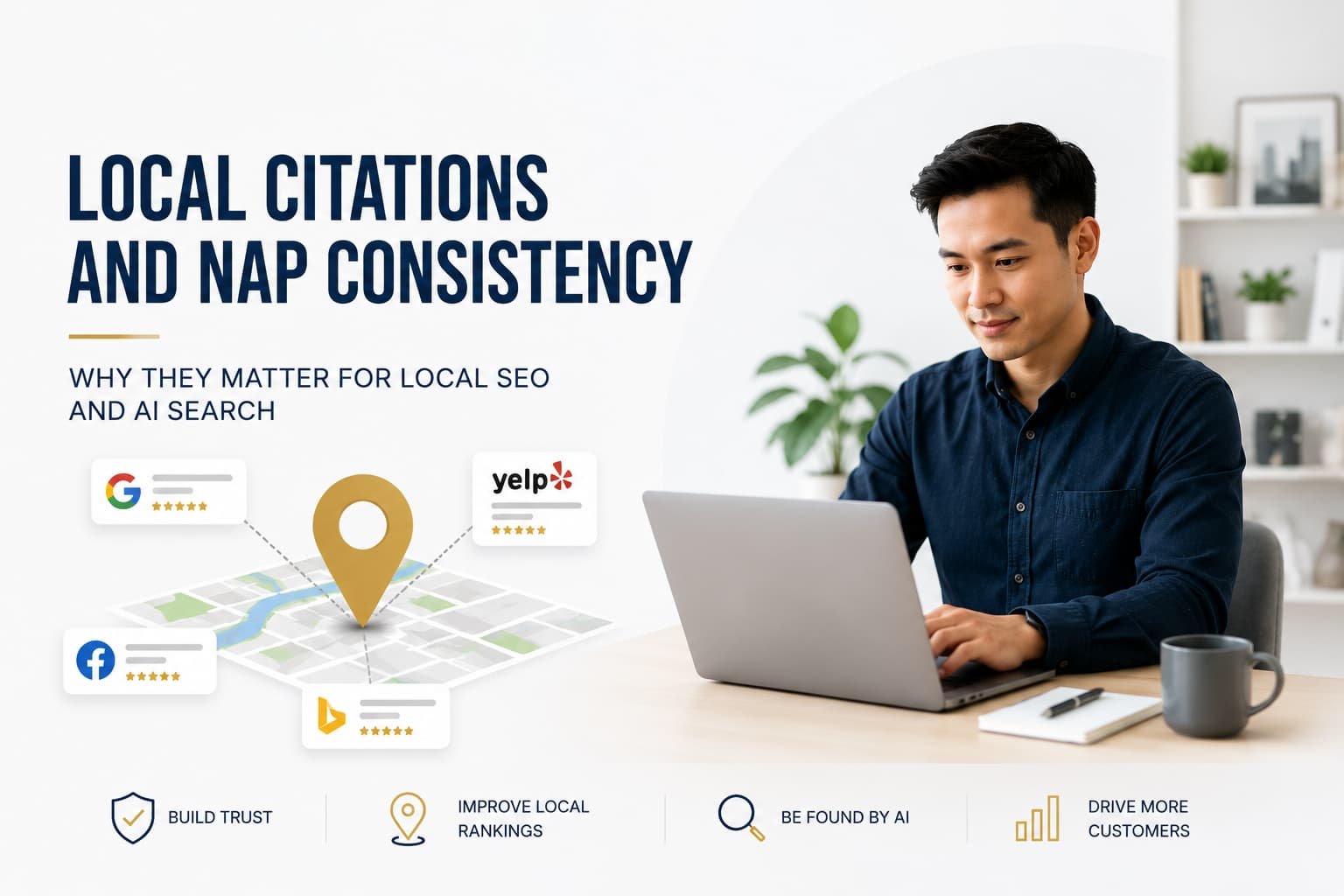
Local Citations and NAP Consistency: Why They Matter for Local SEO and AI Search
-
Local SEO and Google Business Profile: The Complete Optimization Guide
-

Healthcare Marketing vs. SEO: What’s the Difference
-

Medical SEO Company vs. In-House: How to Choose the Right Approach
-

SEO for Doctors: How Medical Practices Can Win More Patients Online
Not ranking where your customers are searching?
Talk to our SEO specialist team. No obligation, no pressure.