Local SEO Ranking Factors: What Actually Determines Local Search Rankings
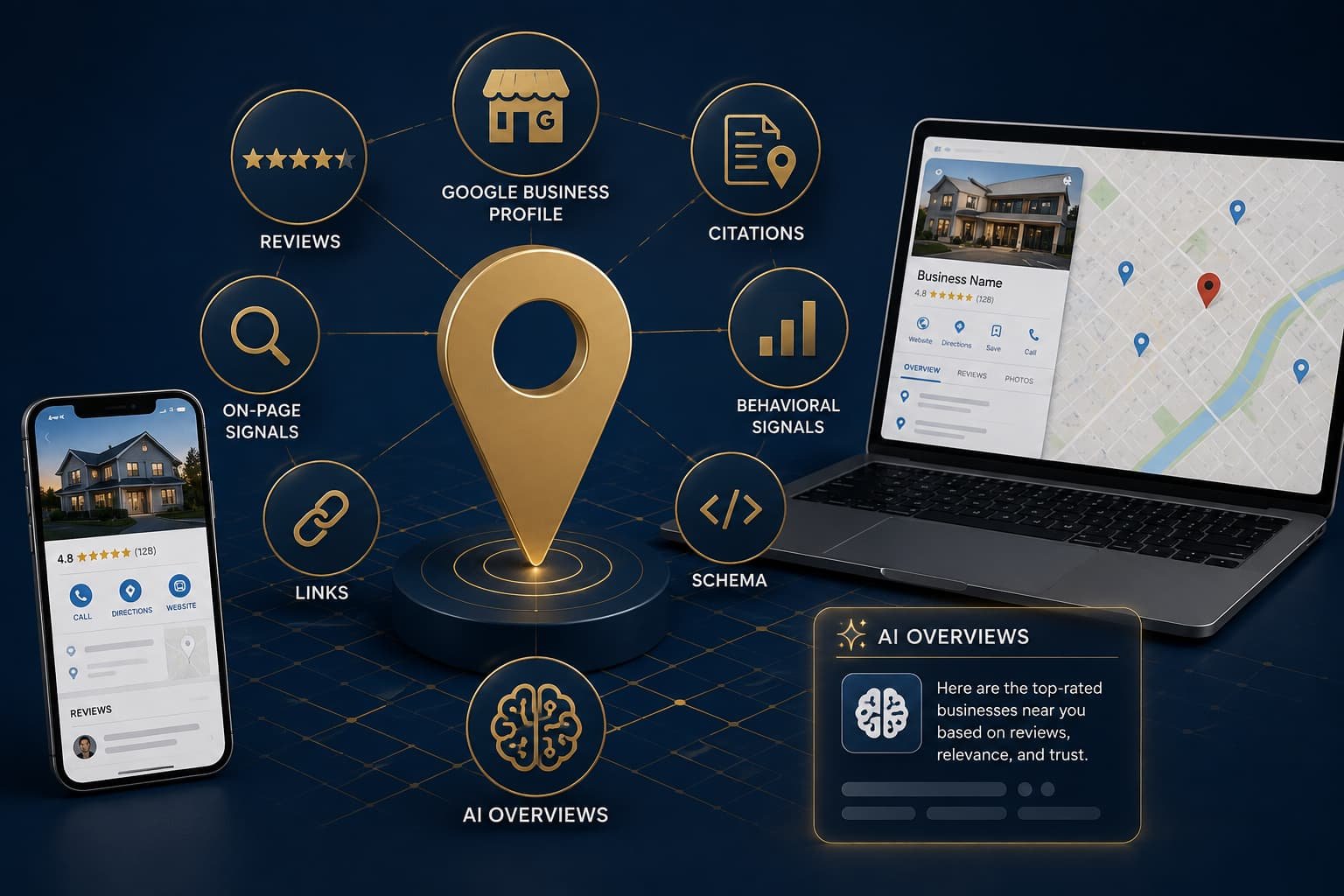
Local SEO ranking factors are the signals Google, and increasingly AI Overviews and LLMs, use to decide which businesses to show for a local search. They range from your Google Business Profile and reviews to citations, on-page signals, links, and how real searchers behave once they find you. Here’s what actually moves the needle, and what’s changed now that AI is part of the equation.
TL;DR: Google’s local ranking algorithm officially runs on three factors: relevance, distance, and prominence. In practice, prominence is built from dozens of underlying signals, your Google Business Profile completeness, review quantity and quality, citation consistency, on-page and website signals, backlinks, behavioral signals like clicks and calls, and structured data. AI Overviews and LLM assistants now draw on many of these same signals, plus how consistently your business’s facts appear across the web, to decide who they recommend.
Table of Contents
- What Are Local SEO Ranking Factors?
- Google Business Profile: The Foundation of Local Ranking Factors
- Reviews and Review Signals
- Local Citations and NAP Consistency
- On-Page and Website Signals for Local SEO
- Backlinks and Local Link Signals
- Behavioral Signals: Clicks, Calls, and Direction Requests
- Schema Markup and Structured Data
- How AI Overviews and LLMs Are Reshaping Local Ranking Factors
- Local SEO Ranking Factors Checklist
- FAQ
of consumers now use AI tools for local business recommendations, up from 6% in 2025
Source: BrightLocal, 2026
of consumers require at least 4 stars before they’ll use a business
Source: BrightLocal, Local Consumer Review Survey, 2026
of consumers only weigh reviews written in the last three months
Source: BrightLocal, Local Consumer Review Survey, 2026
What Are Local SEO Ranking Factors?
Local SEO ranking factors are the signals search engines use to decide which businesses to show, and in what order, for a search with local intent: “[service] near me,” “[service] in [city],” or a plain “[service]” search where Google already knows the searcher’s location. Google states its own framework plainly: local ranking comes down to relevance, distance, and prominence.
- Relevance: how well your Business Profile and website match what the searcher is looking for
- Distance: how far your business, or your service area, is from the searcher or the location they specified
- Prominence: how well-known your business is, both on Google and across the web
Distance is largely outside your control, you can’t move your business closer to every searcher. Relevance and prominence, on the other hand, are built from dozens of specific, controllable signals, which is what the rest of this guide breaks down.
It helps to think of these factors working together rather than in isolation. A plumber with a perfectly optimized Google Business Profile but zero reviews will struggle to outrank a well-reviewed competitor with a thinner profile, because prominence is doing most of the work in a crowded local pack. Likewise, a business with excellent reviews but an incomplete profile or inconsistent citation data can lose ground to a less-established competitor simply because Google can’t confirm the basics confidently enough. The businesses that consistently win local visibility treat all of these factors as one connected system, not a checklist to complete once and forget.
Google Business Profile: The Foundation of Local Ranking Factors
Your Google Business Profile (still often called GMB, Google My Business, its former name) is the single biggest lever for local ranking factors, because it’s what most directly populates the local pack and Google Maps. A complete, accurate, actively maintained profile signals both relevance and prominence at once.
Categories, Attributes, and Photos
The single most accurate primary category, plus every relevant secondary category, tells Google exactly what you do and who you should rank for. Attributes add further specificity, “wheelchair accessible,” “online estimates,” “women-owned,” whatever genuinely applies, and real, current photos of your team, location, and completed work support both relevance and the trust signals that feed prominence. See our Google Business Profile optimization guide for the full checklist.
Posts, Q&A, and Ongoing Activity
Google Business Profile isn’t a set-it-and-forget-it listing. Regular Posts (offers, updates, announcements), an actively monitored Questions & Answers section, and a complete Products or Services list all signal to Google that the profile is maintained by a real, active business, and they give both searchers and AI tools more specific content to match against a query. A profile that hasn’t been touched in over a year sends a weaker signal than one with recent activity, even if the underlying business details haven’t changed. Seed your own Q&A section with the questions customers actually ask, so the answer is already there and accurate instead of left to a stranger’s guess.
Reviews and Review Signals
Review count, average rating, recency, and how you respond all factor into prominence, and they shape whether a searcher actually converts once they find you. Consumer expectations have climbed sharply: 68% of consumers now require at least 4 stars before they’ll use a business, and star-rating thresholds have risen year over year as AI-assisted research makes it easier for consumers to compare businesses quickly.
Review Velocity and Recency
Recency matters as much as volume. 74% of consumers only weigh reviews written in the last three months, which means a business with 200 reviews from three years ago and none since can lose ground to a newer competitor with fewer, fresher reviews. A simple, repeatable process for asking happy customers for a review right after a completed job or appointment, paired with responding to every review, positive and negative, within a few days, does more for this signal than any single tactic.
Review platforms beyond Google matter too, especially Yelp for consumer-facing businesses and industry-specific platforms for fields like healthcare (Healthgrades, WebMD) or home services (Angi, HomeAdvisor). Google doesn’t treat every platform equally, its own reviews carry the most direct weight for local pack ranking, but a business with strong, consistent ratings across multiple platforms builds a broader trust signal that both AI tools and cautious customers pick up on when they’re cross-checking a business before reaching out. Responding to negative reviews professionally, without getting defensive, also matters more than it might seem: it’s often the first thing a prospective customer reads when deciding whether to trust you despite an imperfect rating.
Local Citations and NAP Consistency
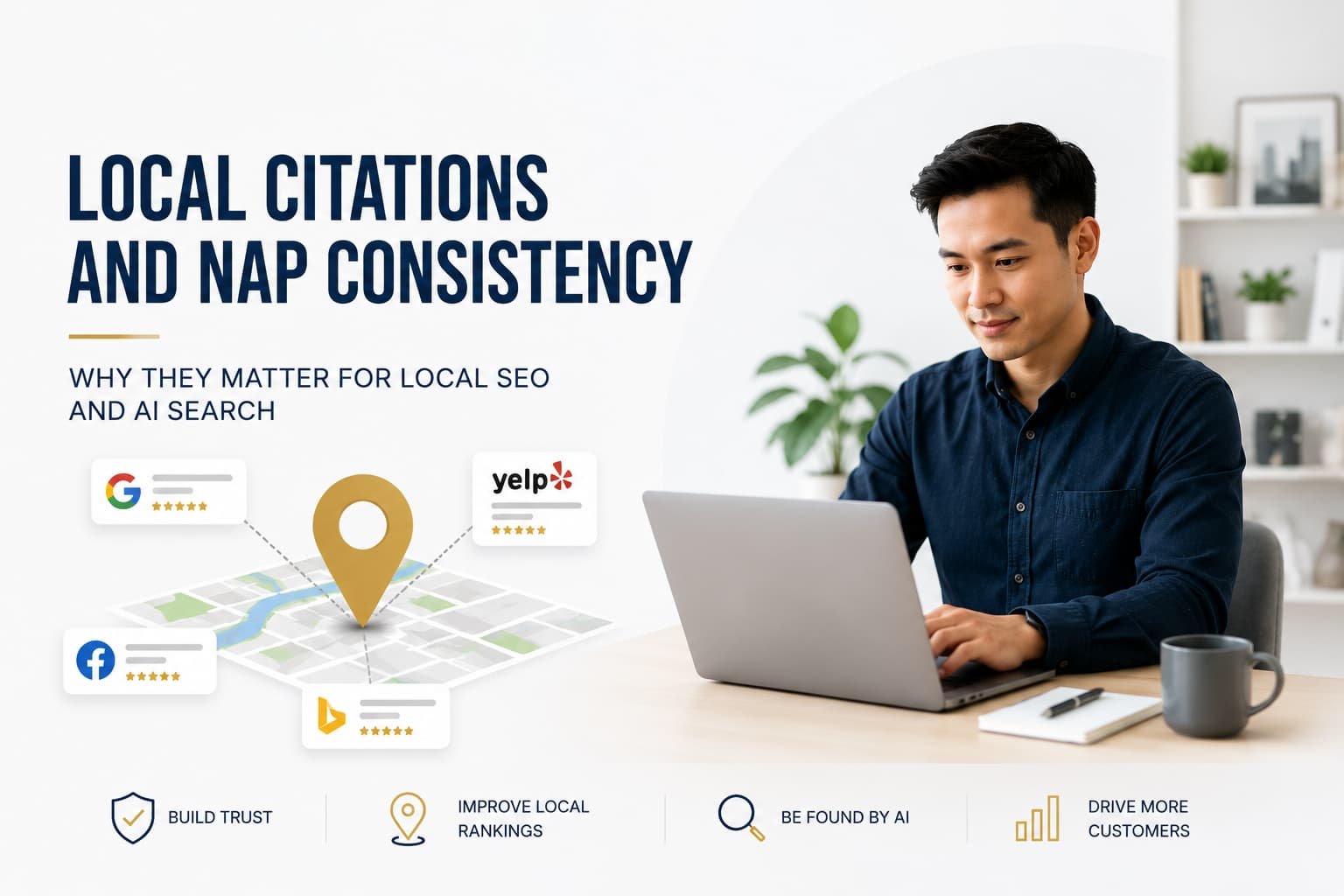
A citation is any online mention of your business name, address, and phone number (NAP), and consistency across every citation is a foundational trust signal for both Google’s local algorithm and AI search tools. Citations have declined somewhat as a pure local-pack ranking factor over the years as Google leans more on behavioral and profile signals, but they’ve taken on renewed importance for AI visibility: mentions and citations function as “the new link” in AI SEO, and a majority of top AI visibility factors are citation-related. This topic has enough depth to deserve its own breakdown, including how structured citations function as semantic triples that help LLMs verify and cite your business confidently, see Local Citations and NAP Consistency: Why They Matter for Local SEO and AI Search for the full guide. The short version: audit your existing citations before building new ones, and make sure every listing, from major data aggregators down to niche industry directories, matches your Google Business Profile exactly.
On-Page and Website Signals for Local SEO
Your website still matters as a ranking factor. On-page signals for local search include your city and service area named naturally in page titles, headings, and body copy, a dedicated page for each service you offer, your NAP repeated consistently in the footer of every page, and content that clearly and specifically describes what you do and where you operate. A generic homepage that never mentions a location or specialty makes it harder for both Google and AI-driven answer engines to confidently match you to a local search.
Local Landing Pages and Location Pages
A business serving multiple cities or a defined service area benefits from a dedicated landing page per location or service, rather than one page trying to rank for everything. Each page should include locally specific content, not a copy-pasted template with the city name swapped out, since thin, duplicated location pages tend to underperform and can even work against you. Real local detail, neighborhoods served, local landmarks, project photos from that specific area, gives both search engines and readers something genuine to work with instead of a template that could describe any city in the country.
Site Speed, Mobile-Friendliness, and Technical SEO
A slow-loading or hard-to-use-on-mobile website works against every other local SEO effort, since most local searches happen on a phone and a frustrating experience sends visitors right back to the search results. Fast load times, a mobile-responsive design, working internal links, and clean, crawlable site structure are table stakes rather than differentiators at this point, but a site that’s neglected them can quietly undercut the impact of otherwise-strong local ranking factors. A basic technical check, page speed, broken links, mobile usability, is worth revisiting periodically even if it isn’t the most exciting part of local SEO.
Backlinks and Local Link Signals
Backlinks remain a ranking factor for local SEO, but the most valuable ones tend to be locally relevant rather than simply high-authority: a mention from the local Chamber of Commerce, a sponsorship or event write-up from a community organization, a feature from a local news outlet, or a link from an industry association specific to your field.
Local Link Building Strategies
Sponsoring a local event, joining your Chamber of Commerce, contributing expertise to a local news story, or partnering with complementary (non-competing) local businesses for cross-promotion all tend to earn the kind of locally relevant links that support both traditional rankings and the topical, geographic signals AI tools look for when deciding who to recommend. A few approaches that consistently work: offering a genuine expert quote when a local reporter is looking for a source, sponsoring a youth sports team or community fundraiser that naturally lists sponsors on its own site, getting listed on your local Chamber of Commerce or Better Business Bureau member directory, and building simple co-referral relationships with businesses that serve the same customers without competing directly, a roofer and a gutter company, for example, or a dentist and an orthodontist. Volume matters less here than relevance: a handful of genuinely local, genuinely earned links outperforms a large batch of generic, non-local backlinks.
Behavioral Signals: Clicks, Calls, and Direction Requests
Google Business Profile Insights tracks how customers found you and what they did next: calls, direction requests, website clicks, and whether they came from a direct, discovery, or branded search. These behavioral signals feed back into prominence over time, a profile that consistently earns clicks and calls looks more trustworthy than one that gets impressions but no engagement. This is also why a complete, appealing profile (photos, accurate hours, a clear description) matters beyond raw completeness, it directly affects whether people act once they see you.
You can influence these signals more directly than it might seem. A profile with a clear, working click-to-call button, accurate hours (especially on holidays, when out-of-date hours are a common source of lost calls), and photos that actually show your work rather than generic stock imagery all make it easier for a searcher to take the next step instead of bouncing back to the results page. Keeping your Products or Services list current and your description specific about what you actually do, rather than generic marketing language, reduces the odds someone clicks through expecting something you don’t offer, which hurts engagement quality even when it doesn’t hurt raw click volume.
Schema Markup and Structured Data
LocalBusiness or Service schema markup on your website spells out your NAP, category, service area, and hours in a format search engines and LLMs are both built to parse directly, reinforcing the same facts your citations already establish. It doesn’t replace the underlying content and citation work, but it removes ambiguity for machines trying to confirm what your business is and where it operates, which supports both classic local pack rankings and AI-driven visibility.
Beyond the core LocalBusiness fields (name, address, phone, hours, priceRange, service area), a few additional schema types are worth adding as they apply: Review or AggregateRating schema so your star rating can display directly in search results, FAQPage schema on pages with a genuine FAQ section (like the one on this page), and Service schema for individual service pages so each one clearly states what it covers. None of this is difficult to implement once, and it’s the kind of one-time technical investment that keeps paying off as AI tools increasingly parse structured data directly rather than inferring facts from unstructured page text.
How AI Overviews and LLMs Are Reshaping Local Ranking Factors
AI Overviews and LLM-based assistants (ChatGPT, Gemini, Perplexity, Google’s AI Mode) are quickly becoming a mainstream way people find and vet local businesses. 45% of consumers now use AI tools for local business recommendations, up sharply from just 6% in 2025, and AI has become the third most-used tool for local business recommendations overall, behind only Google and Facebook, and ahead of Yelp and TripAdvisor.
The underlying signals haven’t changed as much as the interface has. AI tools still lean on the same foundation: your Google Business Profile, your reviews, your citations, and how clearly your website and schema markup describe your business. What’s different is how much they reward consistency and corroboration across independent sources before they’re willing to state a fact confidently.
That shift also changes what “ranking” even means. A local pack listing is a single, ordered result set, you’re either in the top three or you’re not. An AI Overview or a chatbot answer is a synthesized recommendation, and a business can be mentioned, described accurately, and recommended even without holding the literal number-one organic position, provided the underlying signals (profile completeness, review sentiment, consistent citations, structured data) give the AI enough confidence to name you. That’s good news for smaller, well-optimized local businesses that may never outrank a national chain on price or scale, but can absolutely earn a confident, specific AI recommendation by being the most clearly documented, most consistently described option in their area.
Semantic Triples and Structured Citations
This is where citation consistency and structured data stop being a “nice to have” and start being the mechanism AI visibility runs on. A structured citation, a directory listing with your name, address, and phone number in labeled fields, is functionally already a semantic triple: a business paired with a specific, verifiable attribute and value. When that same triple appears identically across dozens of independent citations and your own site’s schema markup, an LLM has exactly the kind of corroborating evidence it needs to cite your business with confidence. See the full breakdown in Local Citations and NAP Consistency. This is part of why optimizing for LLMs and traditional search engines is one connected local SEO offering at Lift SEO Services rather than two separate projects, see AEO, GEO, and SEO for more on how we approach AI-driven search alongside traditional Google results.
Local SEO Ranking Factors Checklist
A short, practical starting point for working through the factors above in order of typical impact:
- Claim and fully complete your Google Business Profile: accurate primary and secondary categories, all applicable attributes, current hours, and real photos
- Post to your Google Business Profile regularly and keep your Products/Services list and Q&A section current
- Build a repeatable process for asking every satisfied customer for a review, and respond to every review within a few days
- Audit your existing citations for NAP consistency before building any new ones
- Make sure every page on your site names your service area and specific services clearly, not just your homepage
- Add a dedicated, genuinely local landing page for each city or service area you serve, if you serve more than one
- Check your site’s mobile experience and load speed, since most local searches happen on a phone
- Pursue a handful of genuinely local backlinks (Chamber of Commerce, local press, community sponsorships) rather than a large volume of generic ones
- Add LocalBusiness or Service schema markup, plus Review and FAQPage schema where applicable
- Keep every one of these consistent and current over time, local SEO rewards ongoing maintenance, not a one-time setup
Want to Know Where You Actually Stand on These Factors?
We’ll show you exactly how your Google Business Profile, reviews, citations, and site signals compare, in traditional search and in AI answers, no obligation.
Frequently Asked Questions
What are the three primary ranking factors for local SEO?
Google states its local ranking framework as three factors: relevance (how well your profile matches the search), distance (how close you are to the searcher), and prominence (how well-known and well-reviewed your business is). Prominence is where most controllable ranking factors, like reviews, citations, and links, actually live.
What is the most important local SEO ranking factor?
Your Google Business Profile has the single biggest impact, since it directly populates the local pack and Google Maps. A complete, accurate, actively maintained profile influences relevance and prominence at the same time, and it’s also the primary source AI Overviews and LLMs pull from for local recommendations.
How do reviews affect local search rankings?
Review count, average rating, and recency all factor into prominence, and they directly affect whether a searcher converts once they find you. 68% of consumers now require at least 4 stars before using a business, and 74% only weigh reviews written in the last three months, so both volume and freshness matter.
Does NAP consistency still matter for local SEO?
Yes, and it matters for a second reason now too. Consistent NAP data across citations remains a core local pack ranking signal, and it’s also become one of the clearest ways AI Overviews and LLMs verify and confidently cite a business. See our full guide on local citations and NAP consistency for more.
How much does proximity affect local search results?
Distance is one of Google’s three core local ranking factors and it’s largely outside your control, you can’t move your business closer to every searcher. What you can control is making sure your service area and address data are accurate and complete, so Google can match you correctly to searchers within your actual reach.
Is SEO dead now that AI Overviews and LLMs exist?
No. AI Overviews and LLM assistants still rely on the same underlying signals local SEO has always focused on, your Google Business Profile, reviews, citations, and website content, they’re just a new destination for that same work to pay off. Ignoring traditional local SEO would mean losing visibility in both places, not just one.
What are behavioral signals in local SEO?
Behavioral signals are the actions searchers take after finding your profile, calls, direction requests, and website clicks. Google Business Profile Insights tracks these, and a profile that consistently earns engagement, not just impressions, builds prominence over time.
Does Lift SEO Services optimize for all of these ranking factors?
Yes. Every local SEO engagement at Lift SEO Services covers Google Business Profile management, review strategy, citation and NAP consistency, on-page and schema work, and link signals, built to support traditional rankings and AI-driven visibility together rather than as separate projects.
What’s the difference between on-page and off-page local SEO factors?
On-page factors are the ones you control directly on your own website: page titles, service and city mentions, content depth, site speed, and schema markup. Off-page factors happen elsewhere: your Google Business Profile, reviews, citations, and backlinks. Both matter, and neither compensates fully for weakness in the other, a great website with no reviews or citations struggles just as much as a well-cited business with a thin, generic website.
How do I do a local SEO audit?
Work through the factors in this guide in order: check your Google Business Profile for completeness and accuracy, review your rating, volume, and recency across platforms, audit your top citations for NAP consistency, confirm your website clearly names your services and service area with reasonable site speed, and check whether you have basic LocalBusiness schema in place. The checklist above is a practical starting point, or we can run a full audit for you and show you exactly where you stand.
Not ranking where your customers are searching?
Talk to our SEO specialist team. No obligation, no pressure.