
What Is a Local SEO, and Why It Matters for Healthcare and Home Service Businesses

If you run a dental practice, an HVAC company, a plumbing business, or a medical clinic, you’ve probably heard the term “local SEO” thrown around by every marketing vendor who’s ever called your front desk. But what is local SEO, actually — and why does it get talked about differently than regular SEO?
Here’s the short version: local SEO is the set of strategies that help your business show up when someone nearby searches for what you do. For a healthcare practice or a home service business, that’s not a nice-to-have. It’s usually the single biggest driver of new patients or new jobs booked, because almost nobody searches “best dentist” — they search “dentist near me” or “dentist in [their city].”
This guide breaks down what local SEO actually is, how it’s different from general SEO, and where to start if you’re new to it.
Table of Contents
- What Is a Local SEO? (Quick Definition)
- How Local SEO Is Different From Traditional SEO
- Why Local SEO Matters More for Healthcare and Home Services
- The Building Blocks of Local SEO
- How Google Decides Which Local Businesses to Show
- How to Find Local Keywords
- How to Perform a Local SEO Audit
- Local SEO Checklist for a New Website
- Local SEO Tools Worth Knowing About
- Local SEO for Multi-Location Businesses
- What Does a Local SEO Company Do?
- Local SEO in Action: A Quick Example
- Where to Start If You’re New to Local SEO
- FAQ
What Is Local SEO?
Local SEO is the practice of optimizing your online presence so your business shows up in search results for people looking for your services in your specific area. That includes your Google Business Profile, your website’s service and location pages, your reviews, and the citations and backlinks that tell Google your business is a real, trustworthy, local operation.
When someone searches “emergency plumber Bowling Green KY” or “medical spa near me,” Google isn’t just trying to find a relevant business — it’s trying to find the closest, most trustworthy, most relevant business to that specific searcher. That’s the whole game of local SEO: proving to Google (and to the person searching) that you’re that business.
Local Search Engine Optimization in Simple Terms
In plain language: local SEO is search engine optimization aimed at your neighborhood instead of the whole country. Regular SEO asks “how do we rank for this topic anywhere?” Local SEO asks “how do we rank for this topic in the specific towns and neighborhoods we actually serve?” It’s a strategy that helps Google understand where a local business’s visibility should show up, using signals like your Google Business Profile, local citations, reviews, and location-specific content to connect your business’s visibility with the customers already searching nearby.
How Local SEO Is Different From Traditional SEO
General SEO and local SEO share a lot of DNA — both care about content quality, site structure, and backlinks. But they optimize for different outcomes, and mixing up the two is one of the most common mistakes healthcare and home service businesses make when they try to handle this in-house.
| Factor | Local SEO | Traditional / National SEO |
|---|---|---|
| Primary goal | Rank in a specific city, region, or service area | Rank nationally or globally for a topic |
| Where you show up | Google Map Pack, local organic results, Google Maps | Standard organic search results |
| Key ranking signals | Google Business Profile, reviews, local citations, proximity to searcher | Backlink authority, content depth, topical relevance |
| Content strategy | City/service-area pages, local case studies, local backlinks | Broad topic guides, national comparison content |
| Best fit for | Practices and contractors with a physical service area | E-commerce, SaaS, national brands, publishers |
For a healthcare practice or a home service business, almost every dollar of SEO effort should be filtered through the local lens first. A beautifully written blog post that never mentions your service area is doing half the job.
Why Local SEO Matters More for Healthcare and Home Service Businesses
Not every industry needs local SEO equally. E-commerce brands and software companies often compete nationally. But healthcare and home services are about as “local” as a business can get, for a few specific reasons:
- The searches are urgent. “Emergency AC repair” and “urgent care near me” are searches from people who need help today, not next month — and Google’s local results are built to answer exactly that kind of query.
- “Near me” is the default. Very few people search “best HVAC company” without a location qualifier attached, whether they type it or Google infers it from their device.
- Trust has to be established fast. Letting a stranger into your home or trusting a provider with your health are high-stakes decisions — reviews, ratings, and a complete online presence do a lot of that trust-building before the phone ever rings.
- You can’t serve everyone, so you shouldn’t try to rank everywhere. Local SEO focuses your visibility on the exact radius you can actually service, instead of competing for impossible national rankings.
The Building Blocks of Local SEO
Local SEO isn’t one tactic — it’s several working together. Here’s what actually makes up a local SEO strategy.
Google Business Profile
Your Google Business Profile (formerly Google My Business) is the listing that shows up in the Map Pack and on Google Maps. It’s arguably the single most important local SEO asset you have, since it’s the first thing most searchers see and interact with — your hours, photos, services, and review score all live there.
What Is the Google Local Pack?
The “local pack” (sometimes called the “map pack”) is the block of three local business listings, complete with a map, that Google shows above the standard organic search results for searches with local intent. Getting into that local pack is one of the highest-value outcomes in local SEO, since it sits above nearly everything else on the page and pulls a disproportionate share of clicks. Ranking in the local pack depends on the same relevance, distance, and prominence signals that drive local rankings generally — a complete Google Business Profile, consistent citations, and strong reviews all play a role.
Local Citations & NAP Consistency
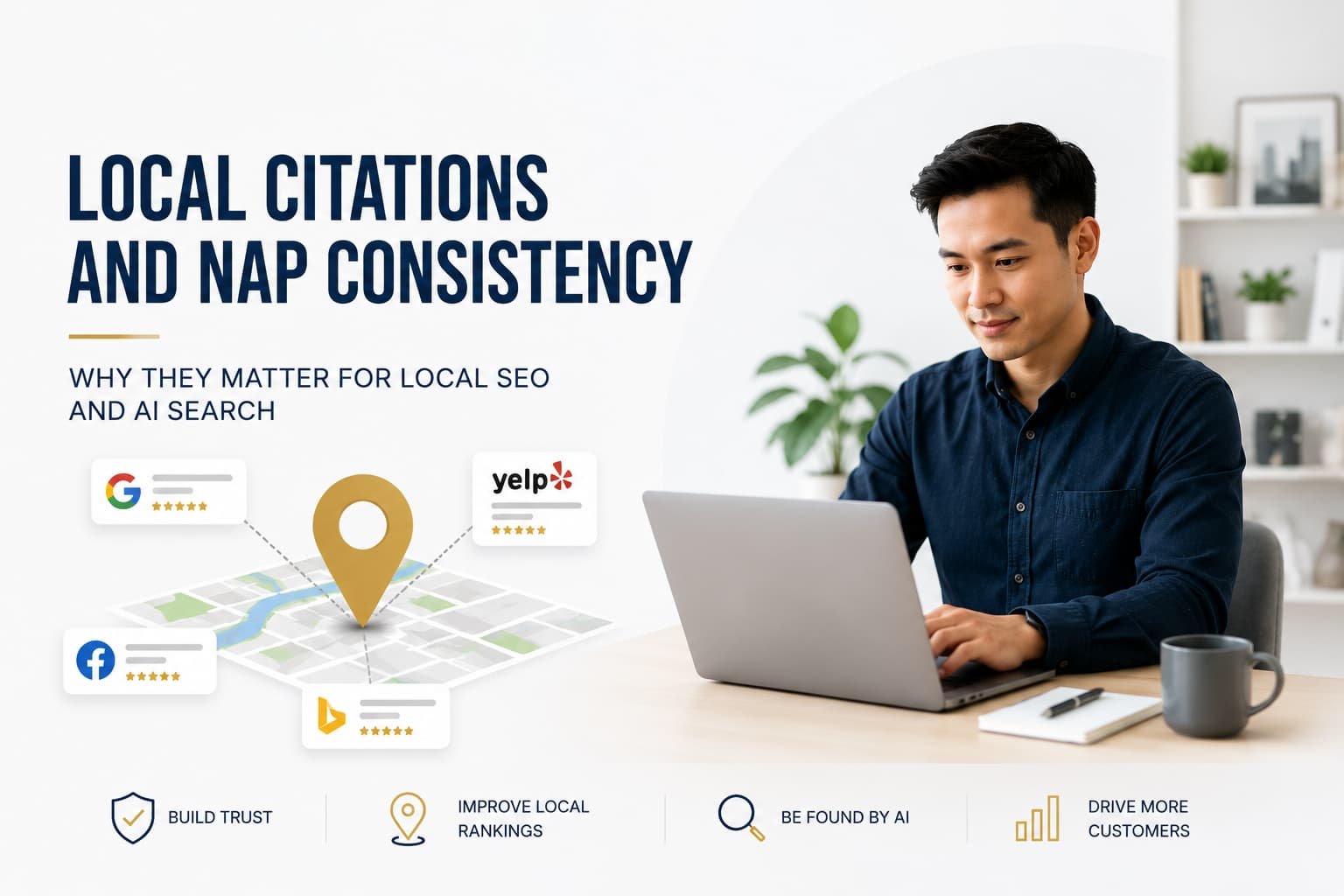
A “citation” is any online mention of your business Name, Address, and Phone number (NAP) — think Yelp, industry directories, the local Chamber of Commerce site, and dozens of others. Consistent, accurate citations across the web are one of the clearest trust signals Google uses to confirm you’re a legitimate local business.
Local Link Building
Local SEO backlinks and local SEO link building work differently than general link building. Instead of chasing high-authority national publications, local link building prioritizes links from other businesses, organizations, and publications in your actual service area — local news coverage, sponsorships, chamber memberships, and partnerships with complementary local businesses.
On-Page Local Content
This is where dedicated service pages and location pages come in. A generic “Services” page tells Google almost nothing about where you operate. A page built around “AC Repair in Bowling Green, KY” tells Google exactly what you do and exactly where you do it — which is what lets you rank for the searches that actually convert.
Reviews & Reputation
Review volume, review recency, and your average star rating all factor into local rankings — and they factor even more heavily into whether a searcher actually calls you once they find you. A five-star Google Business Profile with 200 recent reviews beats a beautiful website with none, every time.
How Google Decides Which Local Businesses to Show in Search Results
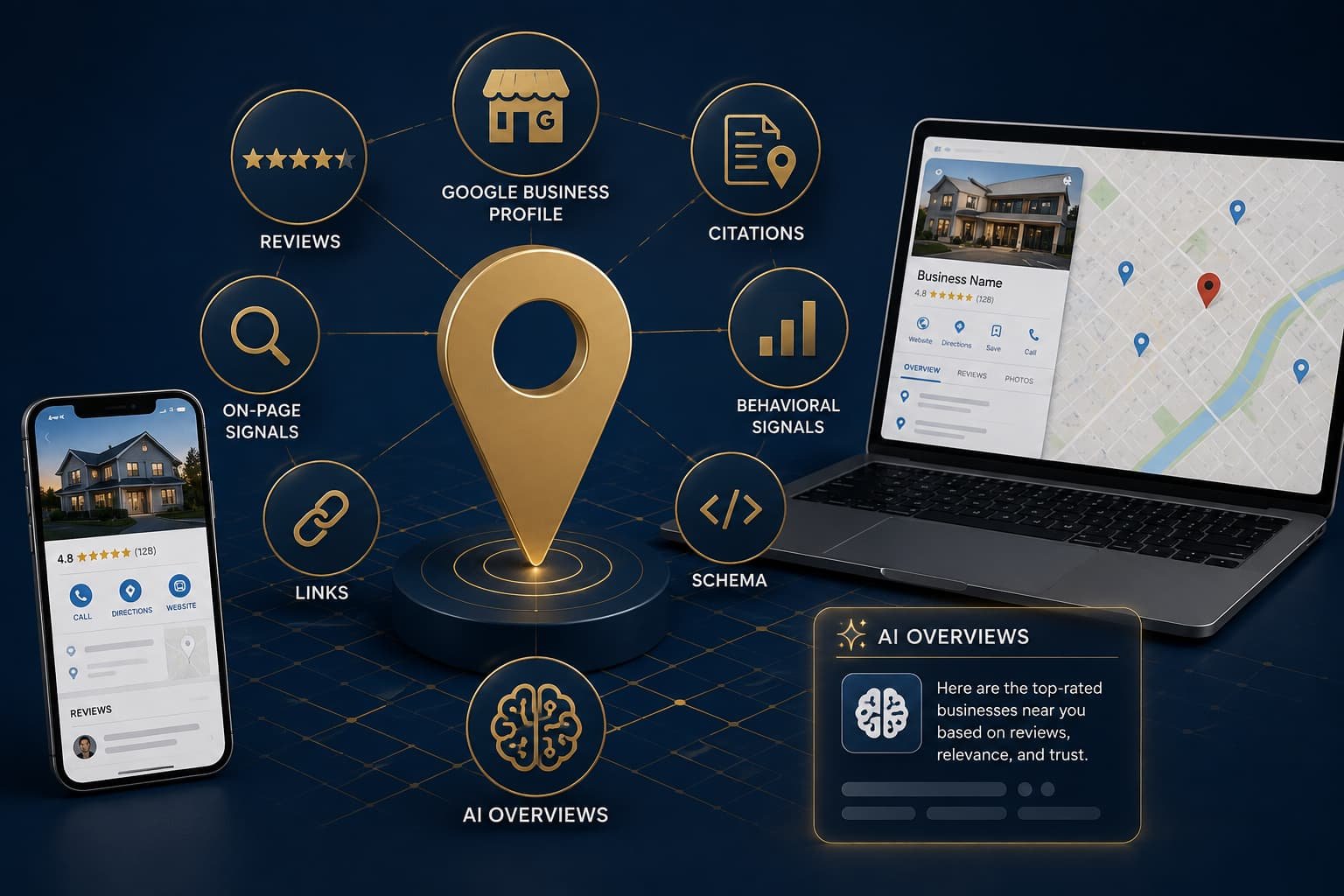
Google has said publicly that local rankings come down to three main factors: relevance (how well your business matches what someone’s searching for), distance (how close you are to the searcher or the area they specified), and prominence (how well-known and well-reviewed your business is, both online and off). Local SEO is, in essence, the practice of improving all three.
Here’s why that’s worth taking seriously:
Local SEO Ranking Factors at a Glance
Relevance, distance, and prominence are the three factors Google names publicly, but in practice, local SEO ranking factors break down into a handful of concrete signals worth tracking:
- Google Business Profile completeness — categories, services, hours, photos, and posting activity
- Review signals — volume, recency, average rating, and how a business responds to reviews
- Citation consistency — accurate, matching business listings across the web
- On-page local content — dedicated service and location pages that clearly state what you do and where
- Local links — backlinks from other businesses, organizations, and publications in your actual service area
- Proximity — how close your business is to the person searching, which you can’t control directly but can optimize around with location-specific pages
How to Find Local Keywords
A local keyword pairs what you do with where you do it — “emergency plumber Bowling Green KY” rather than just “emergency plumber.” To find local keywords worth targeting, start with your core services and combine each one with your city, neighborhood names, and nearby towns you actually serve. Google’s autocomplete and “related searches” both surface real local keyword variations, and a free keyword research tool can help confirm which versions get meaningful search volume before you build a page around one.
Don’t stop at your city name alone — searchers also use landmarks, ZIP codes, and neighborhood names, and building content around those local keywords can capture searches a competitor targeting only the city name entirely misses.
How to Perform a Local SEO Audit
Before investing further in local SEO, it’s worth auditing where you actually stand. A basic local SEO audit walks through five areas: confirm your Google Business Profile is fully complete and accurate, check NAP consistency across your top citation sources, review your website for dedicated service and location pages (versus one generic page trying to cover everything), assess your review volume and recency compared to local competitors, and check whether your core pages actually rank for the local keywords you care about. Several free and paid tools can automate parts of this process, but even a manual pass through these five areas will surface most of the obvious gaps.
Local SEO Checklist for a New Website
Launching a new site is the easiest time to build local SEO in from the start, rather than retrofitting it later:
- Claim and fully complete your Google Business Profile before or immediately after launch
- Build a dedicated page for each core service, written for your actual service area
- Add location-specific content rather than generic, one-size-fits-all copy
- Set up citation listings on the major directories relevant to your industry
- Add schema markup so Google can clearly identify your business type, location, and services
- Put a review-request process in place from day one
Not ranking where your customers are searching?
Talk to our SEO specialist team. No obligation, no pressure.
Local SEO Tools Worth Knowing About
You don’t need a large toolkit to manage local SEO well, but a few categories of tools make the work easier: citation and listing management platforms that help you push consistent NAP data to multiple directories at once, review management tools that centralize review requests and responses across platforms, and rank tracking tools that show how your local keywords are performing over time in your specific service area. Your Google Business Profile dashboard itself is also a free, direct source of local search performance data and shouldn’t be overlooked in favor of paid tools.
Local SEO for Multi-Location Businesses
Local SEO gets more complex once a business operates in more than one city or region. Instead of one generic “Locations” page, each location typically needs its own dedicated page with unique content, its own Google Business Profile, and its own set of local citations and reviews — duplicating the same page across locations with only the city name swapped tends to underperform, since it gives Google very little unique local content to reward. Multi-location businesses also need a clear internal linking structure so customers (and Google) can easily find the right location page for their area.
What Does a Local SEO Company Do to Help with Visilbility?
A local SEO company manages the ongoing work behind everything covered in this guide: Google Business Profile optimization, citation building and cleanup, review generation strategy, dedicated service and location page content, and local link building — plus reporting that ties all of it back to calls, form submissions, and booked business rather than rankings alone. If you’d rather see what that looks like for your specific business.
Local SEO in Action: A Quick Example
Say a homeowner’s water heater starts leaking on a Saturday morning. They pull out their phone and search “water heater repair near me.” Google shows a Map Pack of three plumbing companies, ranked by relevance, distance, and prominence — not necessarily the plumber with the fanciest website, but the one with a complete Google Business Profile, recent reviews, and a dedicated water heater repair page that clearly serves their neighborhood.
That’s the entire local SEO game in one search: be the business Google trusts enough to put in that box, and be the business the homeowner trusts enough to call once they see it.
Where to Start If You’re New to Local SEO
If you’re just getting started, don’t try to do everything at once. Work through these in order:
- Claim and fully complete your Google Business Profile — every field, every category, real photos, accurate hours.
- Audit your NAP consistency across your website, social profiles, and any directories you’re already listed on.
- Build (or fix) dedicated service pages for each core service, written for your actual service area rather than generic copy.
- Set up a simple review-request process so happy customers or patients are consistently asked to leave a review.
- Start earning a handful of genuine local links — local sponsorships, partnerships, and press mentions go a long way.
The Bottom Line
Local SEO isn’t a separate discipline from “regular” marketing — for a healthcare practice or a home service business, it’s most of the job. If you offer healthcare services, start with our Healthcare SEO page to see how this applies to practices specifically. If you’re in HVAC, plumbing, electrical, or another home service trade, our Home Services SEO page walks through the same strategy built for your industry.
Is local SEO different for healthcare practices than for home service businesses?
The core mechanics are the same — Google Business Profile, reviews, citations, local content — but healthcare adds an extra layer of trust and compliance considerations (like accurate provider information and patient privacy in reviews) that home service businesses don’t have to navigate.
How long does local SEO take to show results?
Most businesses start seeing meaningful movement in local rankings within 3-6 months, though Google Business Profile improvements can show impact much faster since that listing updates in near real-time.
Do I need a website if I already have a strong Google Business Profile?
Yes. Your Google Business Profile is often the first touchpoint, but your website is what Google uses to verify relevance and what convinces a searcher to actually book or call — the two work together, not as substitutes for each other.
What is local SEO in simple terms?
It’s search engine optimization focused on your specific service area rather than the whole country — helping your business show up when nearby customers search for what you do, instead of competing for national rankings you don’t need.
How do local citations help SEO?
Consistent citations across directories confirm to Google that your business name, address, and phone number are accurate and that you’re a real, established local operation — inconsistent or outdated citations can quietly hold back local rankings even when everything else is in good shape.
Is local SEO worth it for a B2B company?
It depends on how the company generates business. A B2B company that serves clients within a specific region or metro area still benefits from local SEO fundamentals like Google Business Profile and location-specific content, but a B2B company selling nationally or internationally with no physical service area will get more value from traditional SEO instead.
-
Local SEO Ranking Factors: What Actually Determines Local Search Rankings
-
Local Citations and NAP Consistency: Why They Matter for Local SEO and AI Search
-
Local SEO and Google Business Profile: The Complete Optimization Guide
-

Healthcare Marketing vs. SEO: What’s the Difference
-

Medical SEO Company vs. In-House: How to Choose the Right Approach
-

SEO for Doctors: How Medical Practices Can Win More Patients Online
Not ranking where your customers are searching?
Talk to our SEO specialist team. No obligation, no pressure.